Showing posts with label perennials. Show all posts

Tuesday, June 12, 2012

Spring Combinations II

Delicate peach Iris
turns dramatic when paired with
bright blue perennial Salvia.

Effective combinations bring out the best in plants.

Here are a few
that caught my eye around town
earlier this spring....
Photo taken at Hershey Gardens
Blue Star (Amsonia hubrichtii) and yellow Iris
emphasize deep purple spikes of
Caradonna Meadow Sage (Salvia nemorosa 'Caradonna'),


Evening Primrose (Oenothera speciosa) and Blue Flax (Linun lewisii) 
create cool waves of color.


This casual bank covering seems like
a good spot for the drought tolerant
Evening Primrose, which can spread aggressively.
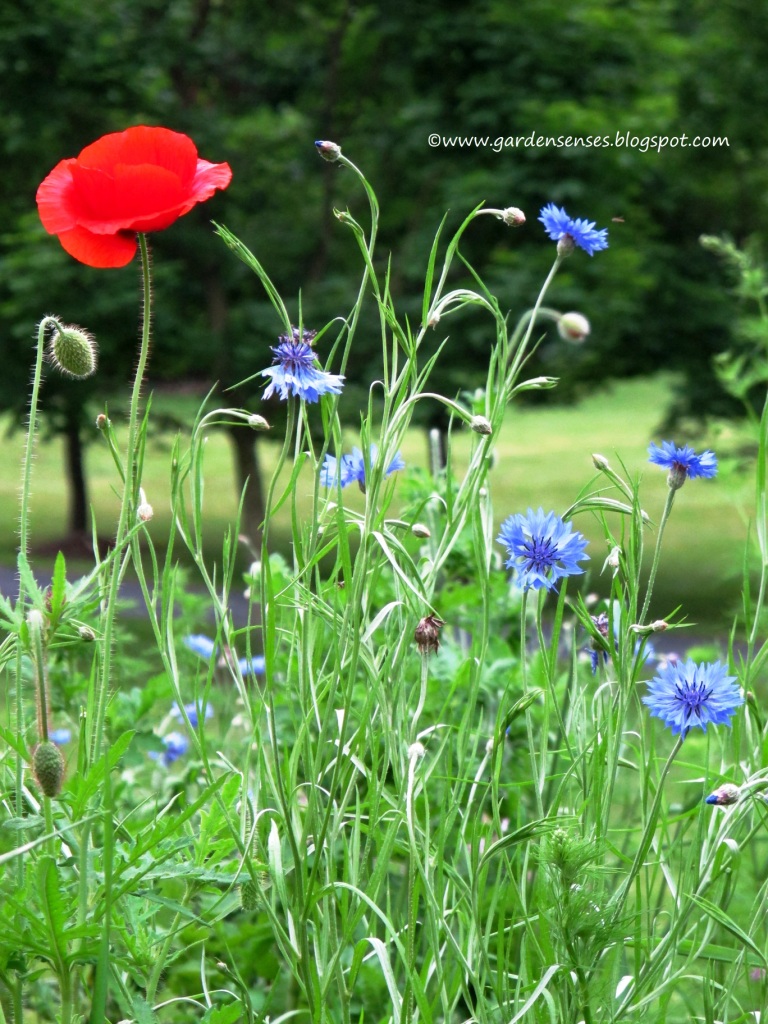

Red poppies (Papaver) and
Blue Cornflower (Centaurea cyanus)
make a free and easy duo.


A pretty pink and blue palette:
Perennial Salvia (Salvia 'May Night' - middle right)
Catmint (Nepeta racemosa - bottom left)
Blue False Indigo (Baptisia australis - top right corner)
Coralbells (Heuchera - center)
Deep pink Knockout roses (top)
Pale pink carpet roses (middle left)

See more spring combinations here.

Friday, April 13, 2012

Scilla Siberica - Be Careful What You Wish

I fell in love with Siberian Squill (Scilla siberica) from
photos showcasing 
naturalized masses of dainty blue flowers
cheering up woodland scenes.


I've long admired these swathes of 
clear blue blooms
in a lovely garden in town.


So pretty with daffodils.

  
But this year, the show got a bit out of control.  
The scilla has jumped the bounds of neatly groomed beds and 
spread across the lawn.


It's even spread 
across the street and 
taken over the neighbors yard.

  
Siberian Squill's ability to create a 
dramativ show is due to its
hardiness and tendency to spread,
both by bulb offshoots and self-seeding.
But this strength can turn into its biggest liability.


I've been trying to determine 
whether Scilla siberica is invasive, and 
have read conflicting reports.
I've not found a definitive indication that 
Scilla siberica is truly invasive.
However, this example highlights the 
importance of understanding the 
characteristics of plants you plant in your garden.

Update:
For more information on 
Scilla siberica's invasive qualities, 
read the last few comments below-
several share their 
inability to remove scilla from their gardens.


While charming photos of
bright blue Scilla siberica may lure you,
be careful what you wish for...
before long you may have more than you bargained for.

If you choose to plant it,
plant it where its spreading nature will be welcome,
not where it will create future frustration.


Tuesday, February 28, 2012

Shimmering Crocus Sea


Bright Snow Crocus blooms
burst through winter's bubble. 


Snow Crocus (Crocus tommasinianus)
comes early, as its name suggests.

A beautiful sight,
they arrive just when you
feel that winter will never end.

I happened upon this 
sea of purple in mid February, 
a feast for my color starved eyes.


Crocus tommasinianus naturalizes,
spreading by offsets and self-seeding.

I can't imagine these beauties bothering anyone,
but the small corms can be  
difficult to sift from soil once established. 


 Snow Drops (Galanthus),
another early bloomer, make a
nice companion planting.


Can spring be far behind?


To see more winter bloomers, click here.


Wednesday, December 7, 2011

Gaura and Grasses

Gaura may not be spectacular on its own,
but paired with grasses,
and it fairly shines in the fall. 

One sunny October day, 
these gentle star like blooms
cradled in feathery grasses
caught my attention as I drove by. 


Fountain Grass (Pennisetum alopecuroides)
does a good job of supporting
Gaura's (Gaura lindheimeri) sprawling stems,
its soft fronds contrasting
the bright blossoms. 


Gaura is hardy in zones 6 - 9, 
 but doesn't always winter reliably. 
Requiring good drainage,
it tolerates some drought.
Gaura likes sun or partial shade.
It will reseed if spent blooms are left on the plants.


Gaura has a long bloom time,
from late spring to fall.
Though I pass this garden a couple of times a week,
I didn't notice it until the fall, when
other flowers faded, making way for
Gaura to move into the spotlight.


Purple Fountain Grass (Pennisetum setaceum 'Rubrum') and
Maiden Grass (Miscanthus sinensis),
shimmer in autumn light and
complete the scene.

Sunday, November 6, 2011

Glorious Grasses at Hershey Gardens

 Grasses and Chrysanthemums
brought the annual beds at
Hershey Gardens
into fine fall form 
when I visited in early October.

 Graceful Purple Fountain Grass (Pennisetum setaceum 'Rubrum') 
starts blooming in July,
but is right at home in the fall garden.


Hardy in zones 9 and 10,
it's grown as an annual here in Pennsylvania.
Like a chameleon, it seems to
adjust to any color scheme.

Purple Fountain Grass hues
blend beautifully with
Tropicanna Canna Lily, while its
feathery form provides great contrast. 


Sky Rocket Fountain Grass (Pennisetum setaceum 'Sky Rocket') is an
interesting variegated variety for a lighter look.


Beginning coppery red blooms of
Morning Light Japanese Silver Grass (Miscanthus sinensis 'Morning Light') 
have a kind of a funky spiky flair.
They'll mature into silvery white plumes.
See how this grass is woven into the
rhythm of the gardens here.


Popcorn Plant (Cassia didymobotrya)
not only has an intriguing look,
but enticing aromas as well. 
Its foliage smells like popcorn
when rubbed or moved (truly!).


I love this juxtaposition of
Blue Mist Spirea (Caryopteris x clandonensis) against
complementary orange mums.
I featured it last year with
Chrysanthemum combinations here .


I was surprised to see Spiderwort (Tradescantia bracteata) flowering. 
Cutting it back after the spring bloom
can encourage this second bloom.


Containers were full to overflowing -
early fall's abundance is bittersweet, with
winter waiting just around the corner. 

See more of Hershey Gardens early fall beauty here.

Tuesday, October 4, 2011

Late Summer Combinations III

I'll finish out late summer combinations 
with a few more picks, 
seen around town in late August.

Late blooming Hosta (Hosta plantaginea)
fly high above Autumn Joy Sedum (Sedum 'Autumn Joy'),
just starting to gain a rosy glow.


Two of my favorite late summer perennials:
  • The electric blue flowers of Dwarf Plumbago (Ceratostigma plumbaginoides - front)
  • A late blooming variety of Black-Eyed Susan (Rudbeckia fulgida var. fulgida).
Combined with waning blooms of
Blue Fortune Hyssop (Agastache 'Blue Fortune') and
Lilyturf (Lirope muscari - a few small spikes peeking through in the top right corner),
they make a sunny corner of color.

Garlic Chives (Allium tuberosum) and 
annual Nasturtium are a
treat for the eyes as well as the stomache -
both are edible.

Check out these recipes for

Garlic Chive (Allium tuberosum) bloom


Graceful plumes of Fountain Grass (Pennisetum alopecuroides - left)
add flair to any grouping in late summer. 
It's taking over for the fading flowers of
white Garden Phlox (Phlox paniculata - middle left) and a
dwarf Hydrangea (right), while
Autumn Joy Sedum is just starting its show (middle right).


Fountain grass (Pennisetum alopecuroides)
shouts out from a
sea of purple Verbena.

Autumn Joy Sedum (Sedum 'Autumn Joy'),
still neutral in late August,
creates a muted palette with
Maiden Grass (Miscanthus sinensis) and
Blue Fescue (Festuca glauca).
Purple Switchgrass (Panicum virgatum var.) and the
blue flower spikes of Lilyturf (Lirope muscari)
make a striking pair.

For more great plant combinations, see: 


Related Posts Plugin for WordPress, Blogger...