Showing posts with label spring flowers. Show all posts

Tuesday, June 12, 2012

Spring Combinations II

Delicate peach Iris
turns dramatic when paired with
bright blue perennial Salvia.

Effective combinations bring out the best in plants.

Here are a few
that caught my eye around town
earlier this spring....
Photo taken at Hershey Gardens
Blue Star (Amsonia hubrichtii) and yellow Iris
emphasize deep purple spikes of
Caradonna Meadow Sage (Salvia nemorosa 'Caradonna'),


Evening Primrose (Oenothera speciosa) and Blue Flax (Linun lewisii) 
create cool waves of color.


This casual bank covering seems like
a good spot for the drought tolerant
Evening Primrose, which can spread aggressively.
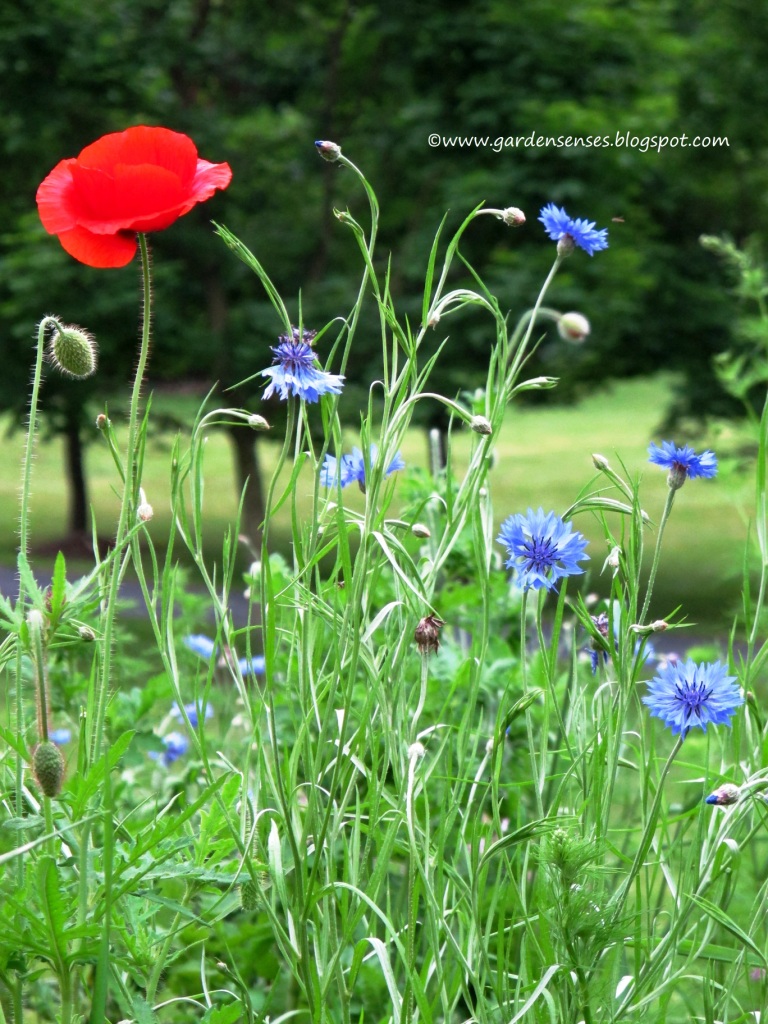

Red poppies (Papaver) and
Blue Cornflower (Centaurea cyanus)
make a free and easy duo.


A pretty pink and blue palette:
Perennial Salvia (Salvia 'May Night' - middle right)
Catmint (Nepeta racemosa - bottom left)
Blue False Indigo (Baptisia australis - top right corner)
Coralbells (Heuchera - center)
Deep pink Knockout roses (top)
Pale pink carpet roses (middle left)

See more spring combinations here.

Friday, April 13, 2012

Scilla Siberica - Be Careful What You Wish

I fell in love with Siberian Squill (Scilla siberica) from
photos showcasing 
naturalized masses of dainty blue flowers
cheering up woodland scenes.


I've long admired these swathes of 
clear blue blooms
in a lovely garden in town.


So pretty with daffodils.

  
But this year, the show got a bit out of control.  
The scilla has jumped the bounds of neatly groomed beds and 
spread across the lawn.


It's even spread 
across the street and 
taken over the neighbors yard.

  
Siberian Squill's ability to create a 
dramativ show is due to its
hardiness and tendency to spread,
both by bulb offshoots and self-seeding.
But this strength can turn into its biggest liability.


I've been trying to determine 
whether Scilla siberica is invasive, and 
have read conflicting reports.
I've not found a definitive indication that 
Scilla siberica is truly invasive.
However, this example highlights the 
importance of understanding the 
characteristics of plants you plant in your garden.

Update:
For more information on 
Scilla siberica's invasive qualities, 
read the last few comments below-
several share their 
inability to remove scilla from their gardens.


While charming photos of
bright blue Scilla siberica may lure you,
be careful what you wish for...
before long you may have more than you bargained for.

If you choose to plant it,
plant it where its spreading nature will be welcome,
not where it will create future frustration.


Tuesday, February 28, 2012

Shimmering Crocus Sea


Bright Snow Crocus blooms
burst through winter's bubble. 


Snow Crocus (Crocus tommasinianus)
comes early, as its name suggests.

A beautiful sight,
they arrive just when you
feel that winter will never end.

I happened upon this 
sea of purple in mid February, 
a feast for my color starved eyes.


Crocus tommasinianus naturalizes,
spreading by offsets and self-seeding.

I can't imagine these beauties bothering anyone,
but the small corms can be  
difficult to sift from soil once established. 


 Snow Drops (Galanthus),
another early bloomer, make a
nice companion planting.


Can spring be far behind?


To see more winter bloomers, click here.


Sunday, June 12, 2011

Spring Combinations I


Even better than spring flowers are 
great spring flower combinations.
Take a look at some
pretty pairs spotted
early this spring.

Perky yellow tulips brighten
the receding blue of
Virginia bluebells (Mertensia virginica), above.

Charteuse coral bells (Heuchera var.) and
deep green foliage make a nice foil to accentuate
blue Virginia bluebells (Mertensia virginica).

 
Primary colors blue and red of
grape hyacinth and
cowslip (Primula veris)
make a bright early spring combination.


A quieter color scheme,
grape hyacinth and daffodils
are bright spots
amid new Hosta shoots.

Daffodils clustered around a
star magnolia (Magnolia stellata)
shout out the start of spring.


Fringed bleeding heart (Dicentra eximia), foam flower (Tiarella cordifolia),
Caramel coral bells (Heuchera 'Caramel') and candytuft (Iberis sempervirens)
make a nice spring grouping.


Fringed bleeding heart (Dicentra eximia)
also looks great with
Virginia bluebells (Mertensia virginica) and grape hyacinth.


Or give it a bold textural contrast
with a broad-leaved foliage plant,
like cast-iron plant (Aspidistra elatior).


Shocking pink tulips are another option.
The monocromatic colors create unity while the
textural variety adds interest.


Variegated hosta set a nice stage for
bright pink bleeding heart blooms (Dicentra spectabilis).


Dainty blue Siberian bugloss
(Brunnera macrophylla) flowers provide a
contrasting counterpoint to the
bold foliage of 
variegated Solomon's seal
(Polygonatum odoratum var. pluriflorum 'Variegatum').


Pink tulips echoing the
pale pink hues of weeping cherry,
heighten the effect.


A bright yellow background of
Emerald 'N Gold euonymus
(Euonymus fortunei 'Emerald 'N Gold') 
helps these
red tulips pop. 

 
A single bold tulip and shy bunny are
highlighted within the neutral frame of
Candytuft (Iberis sempervirens) and white variegated hosta.


Tulips and early blooming
PJM Azaleas (Rhododendron 'PJM')
make a pretty pair.


Emerging variegated sedge (Carex var.- front) and
creeping phlox (Phlox subulata - rear) are also
nice companion plants to tulips. 

Make your spring flowers even
more spectacular
by highlighting them
in effective combinations.

Monday, May 30, 2011

Spring Blooms III - Beyond Azaleas

Azaleas

Azaleas and Rhododendrons certainly
light up the spring garden.
For some, they may be a bit too electric.
If you're looking for spring flowering shrubs
with a more subtle show,
check out these options.
 

Rhododendron

The airy white flowers of Slender Deutzia (Deutzia gracilis) are
effective for a number of weeks. 
Deutzia gracilis 'Nikko' is a dwarf variety which
maintains a height of about 2 feet with a spread of 2-5 feet.
Deutzia can be grown in full sun to part shade.

Slender Deutzia close-up.

White flower spikes cover the evergreen
Cherry Laurel (Prunus laurocerasus 'Otto Luyken').
Plant Cherry Laurel in full sun to part shade.


Variegated Weigela (Weigela florida var.)
branches, laden with flowers,
arch gently toward the ground.
For best flowering, site Weigela in full sun.


Weigela 


Weigela 'Wine and Roses' has purplish foliage .

It's easy to see where
Bridalwreath Spirea (Spiraea x vanhouttei) got its common name -
pristine white flowers trace arching brances
to create quite a spring show.

Bridalwreath Spirea flower clusters.
Best in full sun, Bridalwreath Spirea tolerates light shade.


Dwarf Fothergilla (Fothergilla gardenii) has moderately effective spring flowers.
They're an added bonus to its spectacular fall foliage - see it here and here).
Dwarf Fothergilla grows in full sun to part shade.

Feathery Dwarf Fothergilla blooms.


The vibrant yellow-orange flowers of
seemt to glow on the casual-looking,
Japanese Kerria (Kerria japonica 'Pleniflora') shrub.
Grow Japanese Kerria in part shade to shade.

 
Sunny Japanese Kerria flowers.

If you want fragrant Lilac flowers,
but are short on space, consider
Miss Kim Korean Lilac (Syringa pubescens subsp. patula 'Miss Kim').
Miss Kim is a compact variety with good mildew resistance. 
Lilacs bloom best in full sun, but tolerate light shade.

 
Showy white flowers perched along horizontal branches
create a splendid display on 
Doublefile Viburnum (Viburnum plicatum var. tomentosum). 

Doublefile Viburnum grows in sun to part shade.
Doublefile Viburnum flowers

For more spring flowering plants, see
Related Posts Plugin for WordPress, Blogger...