Showing posts with label flowers. Show all posts

Tuesday, June 12, 2012

Spring Combinations II

Delicate peach Iris
turns dramatic when paired with
bright blue perennial Salvia.

Effective combinations bring out the best in plants.

Here are a few
that caught my eye around town
earlier this spring....
Photo taken at Hershey Gardens
Blue Star (Amsonia hubrichtii) and yellow Iris
emphasize deep purple spikes of
Caradonna Meadow Sage (Salvia nemorosa 'Caradonna'),


Evening Primrose (Oenothera speciosa) and Blue Flax (Linun lewisii) 
create cool waves of color.


This casual bank covering seems like
a good spot for the drought tolerant
Evening Primrose, which can spread aggressively.
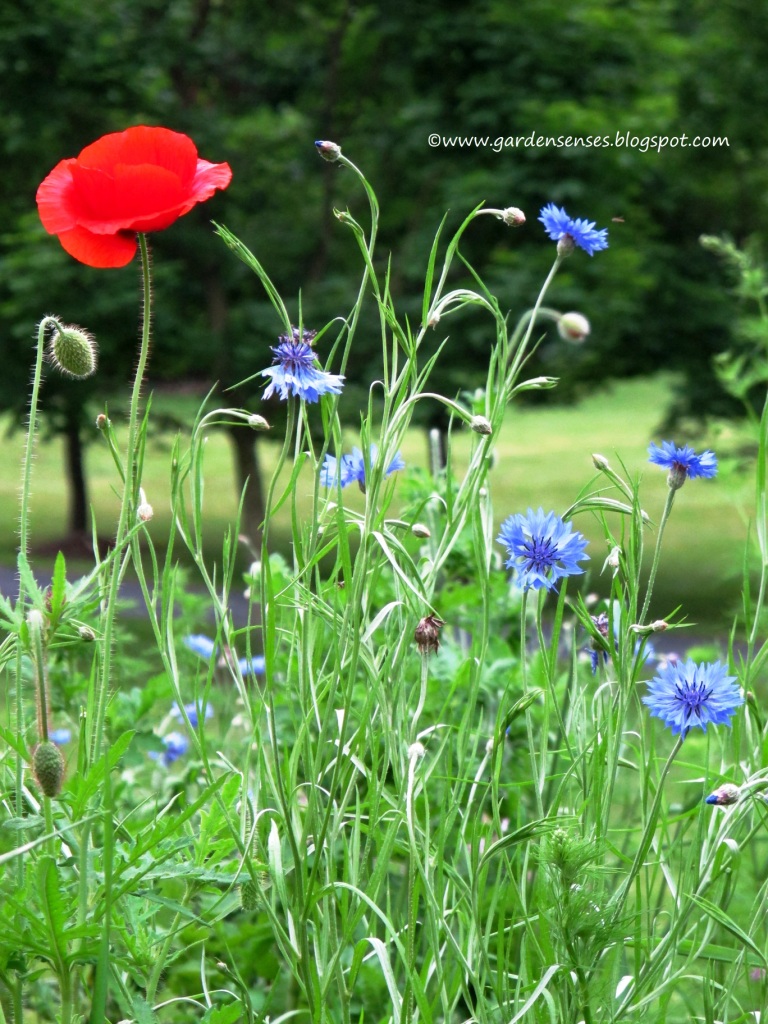

Red poppies (Papaver) and
Blue Cornflower (Centaurea cyanus)
make a free and easy duo.


A pretty pink and blue palette:
Perennial Salvia (Salvia 'May Night' - middle right)
Catmint (Nepeta racemosa - bottom left)
Blue False Indigo (Baptisia australis - top right corner)
Coralbells (Heuchera - center)
Deep pink Knockout roses (top)
Pale pink carpet roses (middle left)

See more spring combinations here.

Thursday, May 17, 2012

Container Gardening Made Easy

I love planting my flower pots.

Shopping is half the fun. 
Wandering through Frey's Greenhouse,
browsing... choosing...
So many possibilities....

I'd love to buy up all that I see...
but I'm typically short on money,
not to mention time for maintenance.

So, I've developed some container gardening strategies to help save on both.

Focus flower pots where they'll provide the most effect. 

Since our deck feels somewhat disconnected from the yard,
a mass container planting helps bring the garden to the deck.
These containers make a huge impact on a well used area
and are well worth the effort.

Basic plastic pots (purchased on sale, of course) cut cost
and conserve water.

Since I can't spring for fancy planters, I make sure they're not the focus.
"Spiller" plants, creep down the planters,
making most of them nearly invisible by mid-summer.
The mass planting creates a corner of color.


Generous sized pots with drip pans help keep watering to a minimum
as they hold more water and allow for larger root systems.
Drip pans provide for overflow to ensure saturation of the soil without waste.
Watering thoroughlly, but less often
encourages healthy root systems.


I use mostly bargain 4 or 6 pack basic annuals to fill my pots.
Adding a few "splurge" plants provides interest without breaking the bank.
Over the years, I've learned which plants perform well in my area
with a minimum of care.


I'm fortunate to have free compost available at our
municipal recycling center, which I use
rather than purchasing potting soil.

I've begun mixing water absorbing granules into 
my potting soil
to help reduce watering.

My 8 oz. packet of Soil Moist Granules
will last me several years -
and help keep my containers going
in spite of my spotty watering schedule. 


Adding slow release granular fertilizer
keeps flowers blooming and growing effortlessly for months.

Enjoy the beauty of container gardening
with minimum cost and effort using these tips:

Cut Cost:
  • Focus on strategic locations
  • Basic containers
  • Use recycled compost
  • Add amendments to soil rather than purchasing pre-mixed
  • Utilize inexpensive 4 or 6 pack annuals, adding a few splurges for interest
Lower Maintenance:
  • Choose self-cleaning flowers (no dead-heading)
  • Generous planters (minimize watering)
  • Plastic or glazed containers with drip pans (minimize watering)
  • Add water absorbing crystals, such as Soil Moist (minimize watering)
  • Add slow release fertilizer (fertilize once and done for the season)


Friday, April 13, 2012

Scilla Siberica - Be Careful What You Wish

I fell in love with Siberian Squill (Scilla siberica) from
photos showcasing 
naturalized masses of dainty blue flowers
cheering up woodland scenes.


I've long admired these swathes of 
clear blue blooms
in a lovely garden in town.


So pretty with daffodils.

  
But this year, the show got a bit out of control.  
The scilla has jumped the bounds of neatly groomed beds and 
spread across the lawn.


It's even spread 
across the street and 
taken over the neighbors yard.

  
Siberian Squill's ability to create a 
dramativ show is due to its
hardiness and tendency to spread,
both by bulb offshoots and self-seeding.
But this strength can turn into its biggest liability.


I've been trying to determine 
whether Scilla siberica is invasive, and 
have read conflicting reports.
I've not found a definitive indication that 
Scilla siberica is truly invasive.
However, this example highlights the 
importance of understanding the 
characteristics of plants you plant in your garden.

Update:
For more information on 
Scilla siberica's invasive qualities, 
read the last few comments below-
several share their 
inability to remove scilla from their gardens.


While charming photos of
bright blue Scilla siberica may lure you,
be careful what you wish for...
before long you may have more than you bargained for.

If you choose to plant it,
plant it where its spreading nature will be welcome,
not where it will create future frustration.


Wednesday, December 7, 2011

Gaura and Grasses

Gaura may not be spectacular on its own,
but paired with grasses,
and it fairly shines in the fall. 

One sunny October day, 
these gentle star like blooms
cradled in feathery grasses
caught my attention as I drove by. 


Fountain Grass (Pennisetum alopecuroides)
does a good job of supporting
Gaura's (Gaura lindheimeri) sprawling stems,
its soft fronds contrasting
the bright blossoms. 


Gaura is hardy in zones 6 - 9, 
 but doesn't always winter reliably. 
Requiring good drainage,
it tolerates some drought.
Gaura likes sun or partial shade.
It will reseed if spent blooms are left on the plants.


Gaura has a long bloom time,
from late spring to fall.
Though I pass this garden a couple of times a week,
I didn't notice it until the fall, when
other flowers faded, making way for
Gaura to move into the spotlight.


Purple Fountain Grass (Pennisetum setaceum 'Rubrum') and
Maiden Grass (Miscanthus sinensis),
shimmer in autumn light and
complete the scene.

Sunday, November 6, 2011

Glorious Grasses at Hershey Gardens

 Grasses and Chrysanthemums
brought the annual beds at
Hershey Gardens
into fine fall form 
when I visited in early October.

 Graceful Purple Fountain Grass (Pennisetum setaceum 'Rubrum') 
starts blooming in July,
but is right at home in the fall garden.


Hardy in zones 9 and 10,
it's grown as an annual here in Pennsylvania.
Like a chameleon, it seems to
adjust to any color scheme.

Purple Fountain Grass hues
blend beautifully with
Tropicanna Canna Lily, while its
feathery form provides great contrast. 


Sky Rocket Fountain Grass (Pennisetum setaceum 'Sky Rocket') is an
interesting variegated variety for a lighter look.


Beginning coppery red blooms of
Morning Light Japanese Silver Grass (Miscanthus sinensis 'Morning Light') 
have a kind of a funky spiky flair.
They'll mature into silvery white plumes.
See how this grass is woven into the
rhythm of the gardens here.


Popcorn Plant (Cassia didymobotrya)
not only has an intriguing look,
but enticing aromas as well. 
Its foliage smells like popcorn
when rubbed or moved (truly!).


I love this juxtaposition of
Blue Mist Spirea (Caryopteris x clandonensis) against
complementary orange mums.
I featured it last year with
Chrysanthemum combinations here .


I was surprised to see Spiderwort (Tradescantia bracteata) flowering. 
Cutting it back after the spring bloom
can encourage this second bloom.


Containers were full to overflowing -
early fall's abundance is bittersweet, with
winter waiting just around the corner. 

See more of Hershey Gardens early fall beauty here.

Sunday, October 16, 2011

Stunning Salvias at Hershey Gardens

The annual beds of Hershey Gardens were
in their glory at the beginning of October.
We had a beautiful, blustery day to
wind our way through the still colorful gardens.
The blooming grasses added their dynamic dimension, 
but they'll have to wait for another post.
For now I'll focus on annuals, and
give Salvias first billing
as the major stars of the show for me.

Salvia 'Mystic Spires Blue' was in gorgeous bloom. 
Hardy to zone 7, it's grown as an annual here in zone 6.

Hot pink Wendy's Wish Sage (Salvia 'Wendy's Wish' - hardy to zone 9)
brings up the rear with dramatic color.
A new variety, I read that part of its
proceeds go to the
Make-A-Wish Foundation.

The casual tangle of
pink Globe Amaranth (Gomphrena globosa)
provides a nice contrast to the vibrant spikes. 


Deep Purple Sage
(middle left - Salvia splendens 'Vista Purple' - tender perennial zones 11a-12b) 
and Wax Begonias
weave waves of color into this
pink and blue tapestry.


The Hershey Chocolate Factory is visible to the right in the background. 
The historic property, where the chocolate company began, has recently been sold, its operations to be relocated to a modern plant. 
The iconic symbol in the heart of town will be missed. 


Black and Blue Salvia (Salvia gauranitica 'Black and Blue' - hardy to zone 8),
is another striking member of the family.
Its electric blue color is set off by black stems and calyces 


I was taken by the dramatic
Cock's Comb Flamingo (Celosia spicata),
a new annual to me. 

A bit gangly in form,it looks suited to the
rear of a bed with fronting plants providing a "skirt".


Mexican Bush Sage
(left foreground - Salvia leucantha 'Cislano' - hardy to zone 8),
is a luscious rich pink-purple color
with a kind of free wheeling habit.

It's easy to see why it's also called Velvet Sage.

I've always loved annual Salvia and am determined to
branch out and try some of these varieties.

Enjoy these glorious the days of early fall,
full of color and life.


Related Posts Plugin for WordPress, Blogger...