Showing posts with label garden design. Show all posts

Wednesday, January 28, 2015

Contrast Adds Interest

While repetition unifies a garden,
contrast makes it interesting
and draws attention to focal points.

Pink tulips pop
in the midst of a sea of pale blue.


Provide contrast by varying color...


...texture...


...form and scale.


As with anything, 
too much of a good thing is not necessarily better.
This riot of color and form is a bit chaotic,
every element vying for attention.


Balance is the key.
Swathes of calming blues and greens of 
Virginia Bluebells, Brunnera and ferns
allow vibrant scarlet tulips 
to take center stage.


Use contrast wisely to
create interest and 
focus attention
in the garden.


Wednesday, January 7, 2015

Repeat for Unity

Repeated pinks and purples
pull this grouping together.

Repetition is an 
easy way to create
unity in the garden.


Repeat colors...


form...

and texture.


Too much repetition is monotonous, 
so contrast is also important. 
Artwork and an architectural canopy
 add interest to this grouping of grasses and daylilies. 


Repeating chartruse color and
small foliage texture
provide unity
while 
large scale elephant ear
and bright orange impatiens
add contrast for interest.


Bring cohesion to your 
garden with 
repetition...
and interest with   
contrast.


Monday, February 25, 2013

Layer for a Lush Look

 
Layering gives a garden a 
full, finished look. 
 
Planting taller plants to the rear with
lower plants in front
adds a sense of depth.
 
Rather than plants plopped in place,
they become part of a cohesive whole.
 

Hide gangly legs...
 
to direct focus
and emphasize
the beauty of a plant.


 Add lower plants...
 
to create contrast and complete the scene.
 
 
Flowers (Black-eyed Susan and Begonia)
lend summer interest and
hide the bare legs of Inkberry (Ilex glabra),
which in turn provides structure and winter presence.


Read about more landscape design strategies here.

Happy Gardening!
Chris
 

Tuesday, October 2, 2012

Create Focus

 
Focal points add interest and
depth to a garden,
lead the eye through a space
and provide a visual resting place. 
 
Create a focal point through contrast - 
a different material, size, shape, texture or color
draws the eye and anchors the scene.
 
The possibilities are limitless...
 
 
...a bit of whimsy in a bird house...
 
 
...style through sculpture...
 
 
 ...a pretty planter against a plain fence...
 
 
...even a well placed tree.


Another way to describe a focal point is
dominence.
Although this planting has
repetition, contrast and interest,
the lack of dominence
means the eye has no place to naturally rest.
It lacks a sense of cohesion.
 
 
Plants can become focal points
that change throughout the year.  
Blue Siberian Iris (Iris siberica) are the star attraction at the moment. 
As the Iris fade, focus will shift to the purple Barberry and pink roses. 
 
In winter, the tree and boulder will take prominence.
 
In fact, all these features provide interest now,
and provide a path for the eye to follow, but
because there is dominance,
the composition feels balanced.
 
 
 Brilliant white blooms
transform a simple lamp post
into a seasonal star.
 
The weeping hemlock 
will step up
when winter works its way
on perennials and deciduous shrubs.
 
Good planning
creates a succession of focus
through the year.
 
 
 Summer Lavender stands out
against a sea of green. 
 
As its flowers fade, 
the grasses will come into
their fall glory,
and steal the scene. 
 
Still later,
stately evergreens
stand ready to take the helm.


 Well placed plants 
"frame" and enhance the focal point,
a soaring Blue Atlas Cedar.


Read about more landscape design strategies here.


Wednesday, March 14, 2012

Mass for Maximum Impact

Plant masses are powerful.
While a flower or two would be lost in all this green,
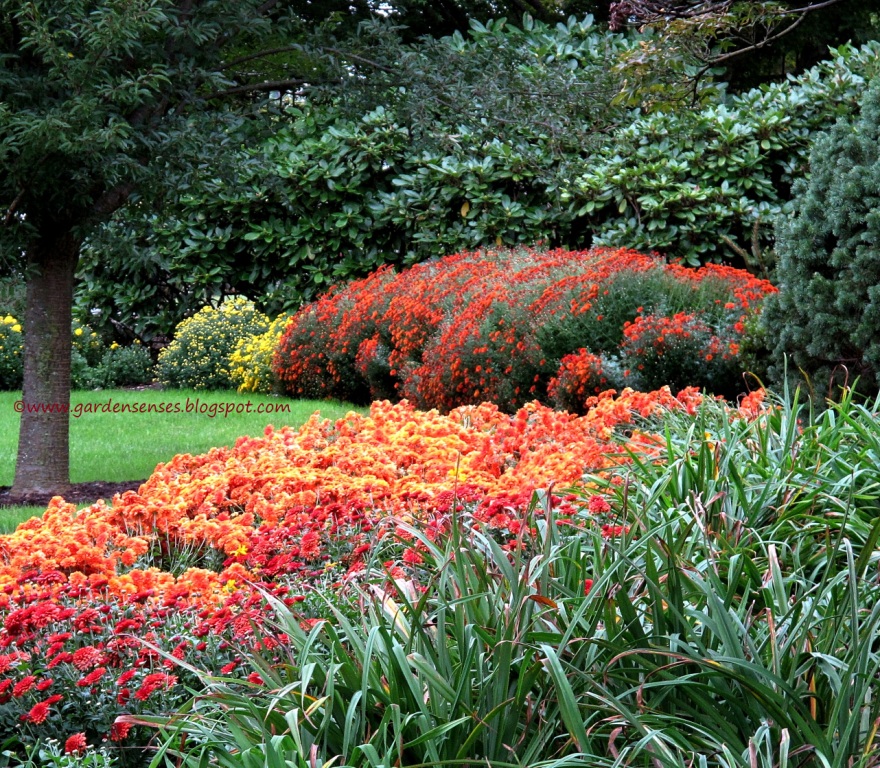
these Mums stop you in your tracks.

Massing, or grouping like plants, helps create
order and emphasis in the landscape.


While the Begonia's above are the same plant,
their alternating colors create an unsettling composition. 
Your eyes can't find a place to rest


The grouping of like colors above, however, 
provides a stable base where
the eye can comfortably rest.


Groupings of 3 or more plants
are pleasing to the eye -
odd numbers are best.

The number of plants you use
depends on the scale of the area to be planted.  
Plants should be spaced so they will 
grow together and "read" as a mass
but have room to spread to their ultimate size.  

Planting too far apart,
or pruning each shrub into a separate ball
detracts from the cohesiveness of a design.


This simple planting,
resting beneath a canopy of trees,
creates a bold impact
even from a distance.


Ground covers make the perfect foil to
highlight a climbing Clematis.
Uniform height helps them read as a mass
in spite of their varied foliage.


Bright color masses,
juxtaposed,
make a dynamic composition.


 I group my flower pots to make a
bigger impact than scattered containers would.
By the end of the summer,
the plants grow together and
create the illusion of a planting bed
on the corner of our deck.

Read here about another important
aspect of landscape design:
Line in the Landscape


Friday, February 4, 2011

Line in the Landscape

Good lines make a bold statement in the landscape.

Line is an important element in the garden.  Good lines help define style, create movement, direct the eye and emphasize focal points. 


Straight lines reflect the formal style of this area at Hershey Gardens.  Although the lines are straight, the design is dynamic, leading your eye to the Miscanthus focal points anchoring the ends of the planting beds.

Curved lines create interest in this informal garden, guiding your focus through the area. 


The curve of this path directs your eye behind the planting and encourages you to investigate the hidden destination.  Although it may seem counter-intuitive, using line to conceal a part of the garden gives the visual impression of a larger space.  A focal point or bench found around the bend is a sweet surprise, making the journey there worthwhile.


Line can be defined by hardscape edges,

 
 by the planting bed edge,


or by sweeps of plants within a planting area.

Not all lines are equal.  This weak line doesn't relate to the plant placement and isn't effective.  Bolder is better.


Photo used with permission from Signature Gardens
  This path, by Toni at Signature Gardens, is an excellent example of effective line.  The bold curve defines the lawn edge and directs your eye to the arbor which entices you to explore the garden further. 
Creating a good line is easier on paper than in the landscape.  To make it work on the ground, lay it out first with a garden hose, which is easily adjusted until you have it right.  You can then use the hose as a guide for edging, or trace the line with spray paint for a longer lasting reference.
The clean line of this planting bed, defined by Junipers, works even in the dead of winter and emphasizes the Miscantus grass focal point.  The lone Miscanthus would stick out like a sore thumb at this time of year without the surrounding Junipers.  While the scene is more vibrant during the summer, the simple evergreen circle surrounding the exclamation point of grass creates a pleasant winter scene.

Heighten interest and intrique in your garden by designing with dynamic lines.
Related Posts Plugin for WordPress, Blogger...